
Introduction
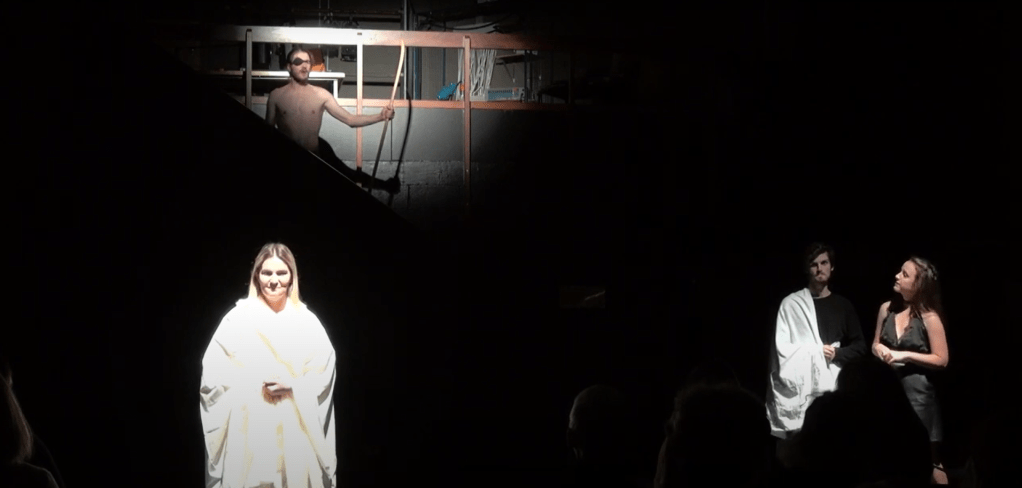
Theatre productions have been an integral part of the German Studies curriculum at The University of Western Australia for many years. In the units taught by Alexandra Ludewig, this involves a creative engagement with literature (not necessarily dramatic texts per se) from different eras and different genres, such as Wilhelm Busch’s Max & Moritz or the Diary of Anne Frank (see Ludewig, 2018 and 2014). Goethe’s Faust has been on the playbill three times since 2020, and due to the pandemic, the students (all at levels B1-C1) had to be particularly agile and creative.
Assessment
In week 1, students are provided with a text and the brief to plan and execute a cultural event by week 10 of semester that is open to the general public. Then they are asked to develop their personal response and performance concept individually which they have to pitch to the entire class in an oral presentation (30%, week 3). Thereafter the class is asked to arrive at a consensus or break up into smaller groups pursuing their respective preferred group concept (min. of 3 students per group).
The identification of a concept and the resulting organisation of the writing process are left entirely to the students, relying on their autonomy and initiative. The respective script(s), complete with stage directions, are submitted for corrections (20%, between weeks 5 and 7) and after incorporating suggestions for improvement, the students proceed in turn with their chosen audio-visual realisation. The learning process is structured and decelerated by phases of action and experimentation which are followed by phases of critique, reflection and learning from experience. Several feedback cycles occur throughout the semester, whereby the students’ level of engagement and participation as well as their self- and peer reflection are the main focus (30% + 10%), and thus weighted higher than the final product (10%, week 10).
Rationale
Methodologically, Ludewig takes her cues from Manfred Schewe’s reflections on aesthetic learning and drama pedagogy (Fremdsprache inszenieren, 1993). In this context, collaborative writing and creating new worlds as a part of cooperative learning is central to Ludewig’s teaching philosophy that values Lehrfreiheit as well as Lernfreiheit.
Furthermore, when students were asked for feedback, this shows that without exception, the students not only had fun, but overcame many fears; from the anxiety of using a foreign language to worries about failure or public speaking (Ludewig & Busse 2019). In addition, the final products (which were recorded and made publicly available) provided important examples of their proficiency in a foreign language as well as their communication and interpersonal skills, which they could reference in job applications and interviews (Ludewig & Benstein 2020).
Further examples
Bibliography:
Ludewig, A., 2014, Dramatische Begegnungen im Fremdsprachenunterricht Mediengeschichten. Siebert, P., Piper, J. & Meoli, A. (eds.). Berlin: Metropol Verlag, pp. 228-241.
Ludewig, A., 2018, Wanted: Max and Moritz, 11 May 2018.
Ludewig, A., Benstein, P. & Ludewig-Rohwer, I., Language learning with performance techniques and flow, 7 Oct 2020, Intersections in Language Policy and Planning: Establishing Connections in Languages and Cultures. Fornasiero, J., Reed, S. M. A., Amery, R., Bouvet, E., Enomoto, K. & Xu, H. L. (eds.). Switzerland: Springer, pp. 185-400.
Ludewig, A. & Busse, W., Jun 2019, Grimms “Hänsel & Gretel” als Fluchtgeschichte: Dramatische Begegnungen im Fremdsprachenunterricht In: Zeitschrift für Theaterpädagogik. 35, 74, pp. 53-54.
 Creative modern languages